
Questo articolo tratta di sostanze psicoattive destinate agli adulti (18+). Consulta un medico se hai condizioni di salute o assumi farmaci. La nostra politica sull'età
How to Dry Cannabis: Step-by-Step Drying Guide
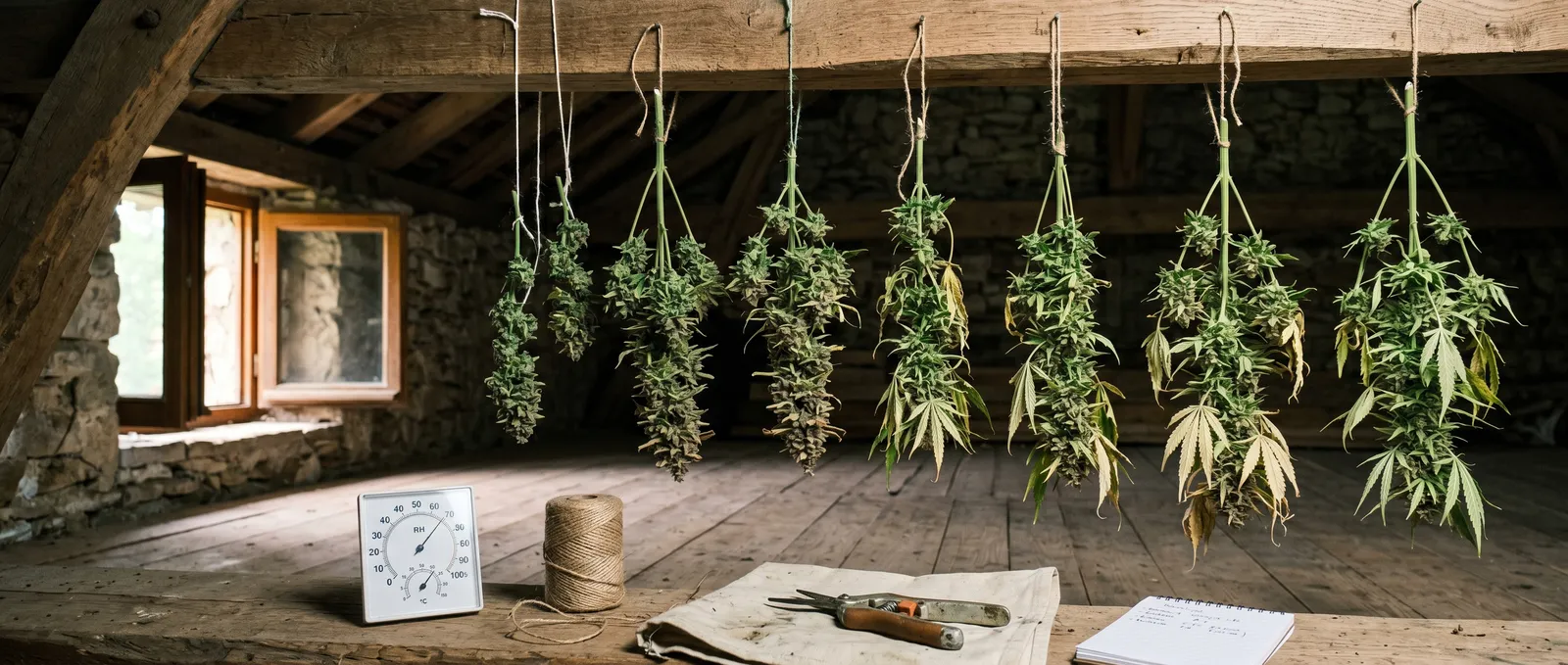
Definition
Drying cannabis is the 7-14 day post-harvest process where 70-75% of flower water weight evaporates at 15-21°C and 55-62% RH, stabilising terpenes and breaking down chlorophyll to preserve potency and prevent mould (Cervantes, 2006).
How to dry cannabis properly
Drying cannabis is the 7-14 day window between harvest and cure where roughly 70-75% of the flower's water weight leaves the bud, terpenes stabilise, and chlorophyll starts breaking down. Get it right and you preserve potency, smoothness, and aroma. Rush it and you get a harsh, hay-smelling smoke — or worse, mould. This guide is written for adults aged 18 and over; cultivation and consumption information applies to adult physiology only.
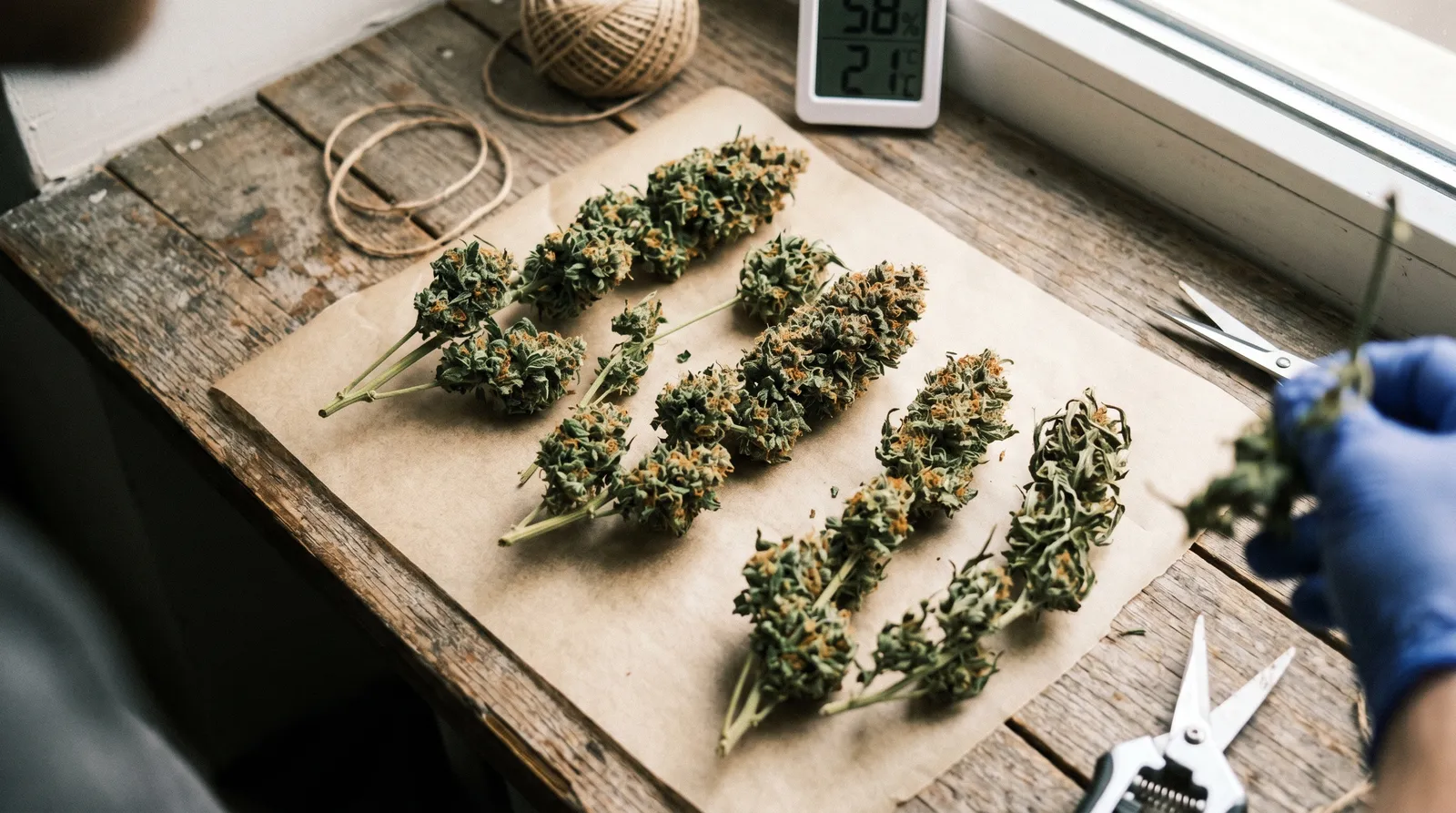
18+ only
Key facts before you hang a single branch
- Target environment: 15-21°C (60-70°F), 55-62% relative humidity, gentle indirect airflow, total darkness (Cervantes, 2006).
- Duration: 7-14 days for hang-drying whole branches; shorter for rack-drying trimmed buds.
- Weight loss: Fresh flower loses approximately 70-75% of its mass during drying (Leafly Cultivation Review, 2021).
- Terpene risk: Monoterpenes like myrcene and limonene begin evaporating above 21°C — warm rooms strip flavour (Birenboim et al., 2023, Postharvest Biology and Technology).
- Mould threshold: Aspergillus and Botrytis colonise rapidly above 65% RH in stagnant air (Punja, 2021, Frontiers in Microbiology).
- Finish test: Smaller stems snap cleanly rather than bend — the classic "snap test" used since at least the 1970s.
- Next step: Curing in sealed jars at 58-62% RH for 2-4 weeks after drying completes the process.
Commercial disclosure
Azarius sells cannabis-adjacent products (seeds in applicable markets, grow equipment, storage jars, hygrometers) and has a commercial interest in this topic. Our editorial process includes independent horticultural and pharmacological review to mitigate commercial bias.
Contraindications and room safety
Before the plant-side instructions: a dedicated drying space should never double as a bedroom. Mould spores shed from drying cannabis — particularly Aspergillus species — can trigger severe respiratory reactions in immunocompromised people, asthmatics, and pregnant individuals (McPartland, 1994, Journal of the International Hemp Association). Anyone with a history of aspergillosis, COPD, or active immunosuppression should stay out of the drying room entirely. Electrical fans and dehumidifiers running 24/7 near plant material also warrant a proper smoke alarm and a circuit that isn't daisy-chained through three extension leads.
A short history of the hang
Hang-drying cannabis upside-down by the stem is older than any written cannabis manual. The practice appears in 19th-century Indian charas preparation notes and in hemp fibre retting guides from Eastern Europe. The modern indoor protocol — cool, dark room, 60% RH, 60°F — was popularised by Ed Rosenthal and Jorge Cervantes in grower manuals from the 1980s onward. Cervantes's Marijuana Horticulture (first edition 1983, revised 2006) codified the "60/60" rule that's still the benchmark. More recently, a 2023 study by Birenboim and colleagues at Israel's Volcani Institute quantified what growers had observed for decades: temperatures above 21°C measurably reduce monoterpene content in dried flower, while slow drying at 18°C preserves the terpene profile closer to the fresh plant.
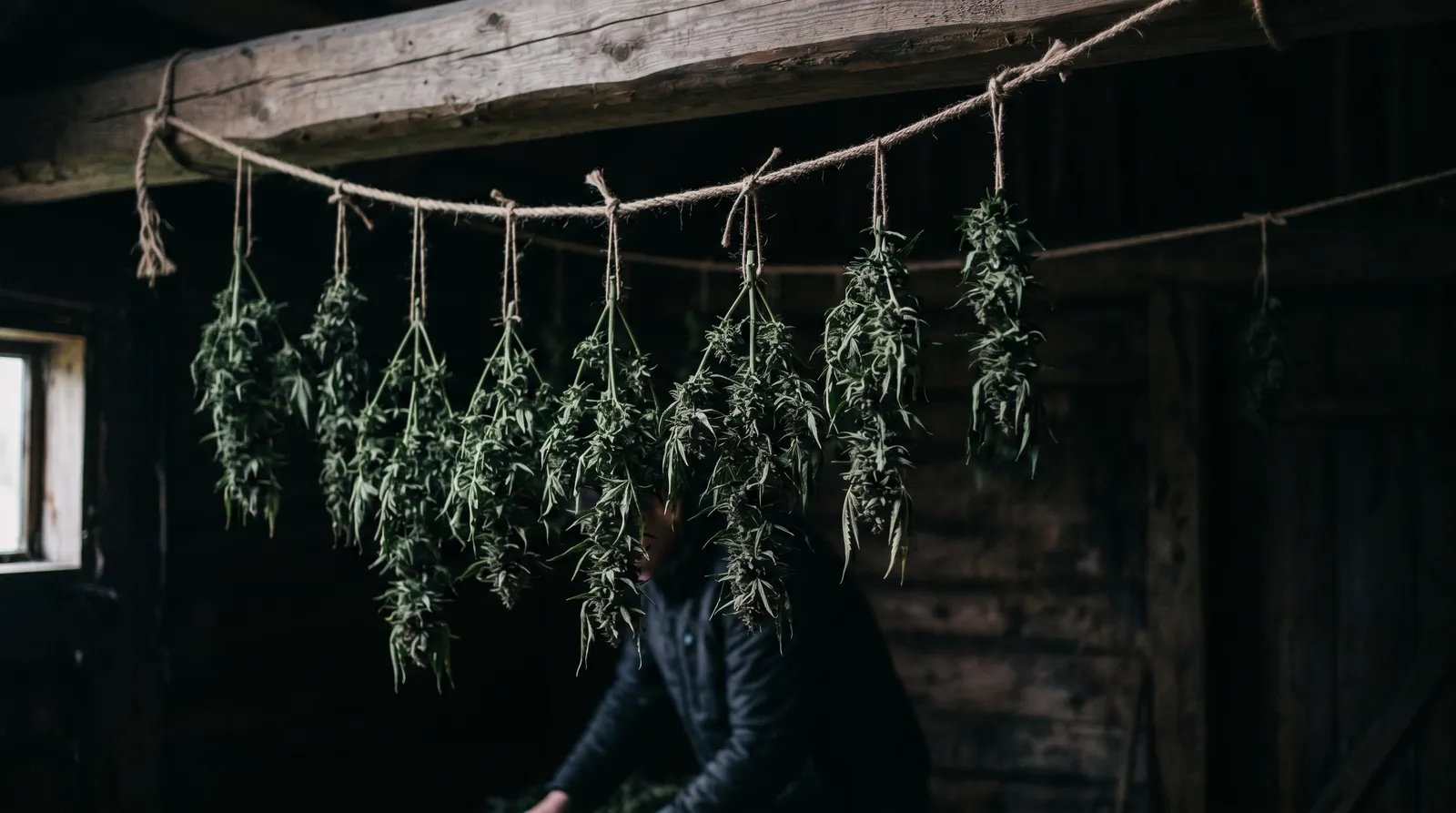
Two of us disagree about whether to leave fan leaves on during hang-drying. One swears the extra moisture buffer slows the dry and protects terpenes; the other calls it a mould invitation. Both of us have produced excellent flower. The honest answer is it depends on your room's humidity more than the leaf question.
What's actually happening in the bud
Drying is a combination of water loss, enzymatic breakdown, and cannabinoid/terpene chemistry. Fresh flower contains roughly 75-80% water by weight, most of it in the leaf tissue and stem. As water evaporates, chlorophyll enzymes continue to degrade for several days — this is why rushed drying (say, 48 hours under heat) produces that grassy, "lawn-clipping" smoke. Proper drying gives chlorophyll time to break down before the moisture is locked out.
Cannabinoids themselves are relatively stable in this window. THCA is the acid form in fresh flower; it decarboxylates to THC only above ~105°C or over very long timescales, so drying at 18-21°C doesn't meaningfully convert it. What does shift is terpene content — and those are the volatile aromatic compounds that smell like pine, citrus, or diesel.
| Compound | Sensitivity during drying | Preserved by |
|---|---|---|
| THCA / CBDA | Low — stable below 70°C | Darkness, cool temps |
| Myrcene | High — evaporates above 20°C | Slow dry, low heat |
| Limonene | High — volatile | Low airflow across bud surface |
| Pinene | Moderate | Sealed curing after dry |
| Linalool | Moderate | Humidity above 55% during dry |
| Chlorophyll | Breaks down naturally | Time — not heat |
One honest limitation: published terpene-retention data comes mostly from a handful of cultivars under lab conditions. Your specific strain grown in your specific room may behave differently, and there is no universal curve that predicts exactly how much myrcene you'll lose at 22°C versus 19°C.
The seven-step drying protocol
Step 1: Prepare the room before you cut
Set up the drying space before harvest. You want 15-21°C, 55-62% RH, total darkness, and gentle indirect airflow. A small bedroom, grow tent, or dedicated closet works. You'll need a hygrometer (absolutely non-negotiable — guessing humidity is how batches die), an oscillating fan on its lowest setting pointed at a wall, and ideally a dehumidifier or small heater depending on your climate. Seal the room from light leaks.
Step 2: Harvest at the right moment
Cut when 70-90% of the trichomes have turned from clear to milky white, with perhaps 10-20% amber. Use a jeweller's loupe or USB microscope — don't eyeball it. Harvest in the morning before lights-on if indoor, as terpene concentration peaks overnight (Tanney et al., 2021, Plants).
Step 3: Wet-trim or dry-trim — pick one
Wet-trim means removing fan leaves and sugar leaves immediately after cutting, then hanging bare buds. Dry-trim means hanging whole branches leaves-and-all, trimming after the dry is done. Wet-trim dries faster and looks cleaner; dry-trim preserves terpenes better because the sugar leaves act as a buffer. In low-humidity climates (below 45% ambient RH), dry-trim is almost always the better choice.
Step 4: Hang upside-down by the stem
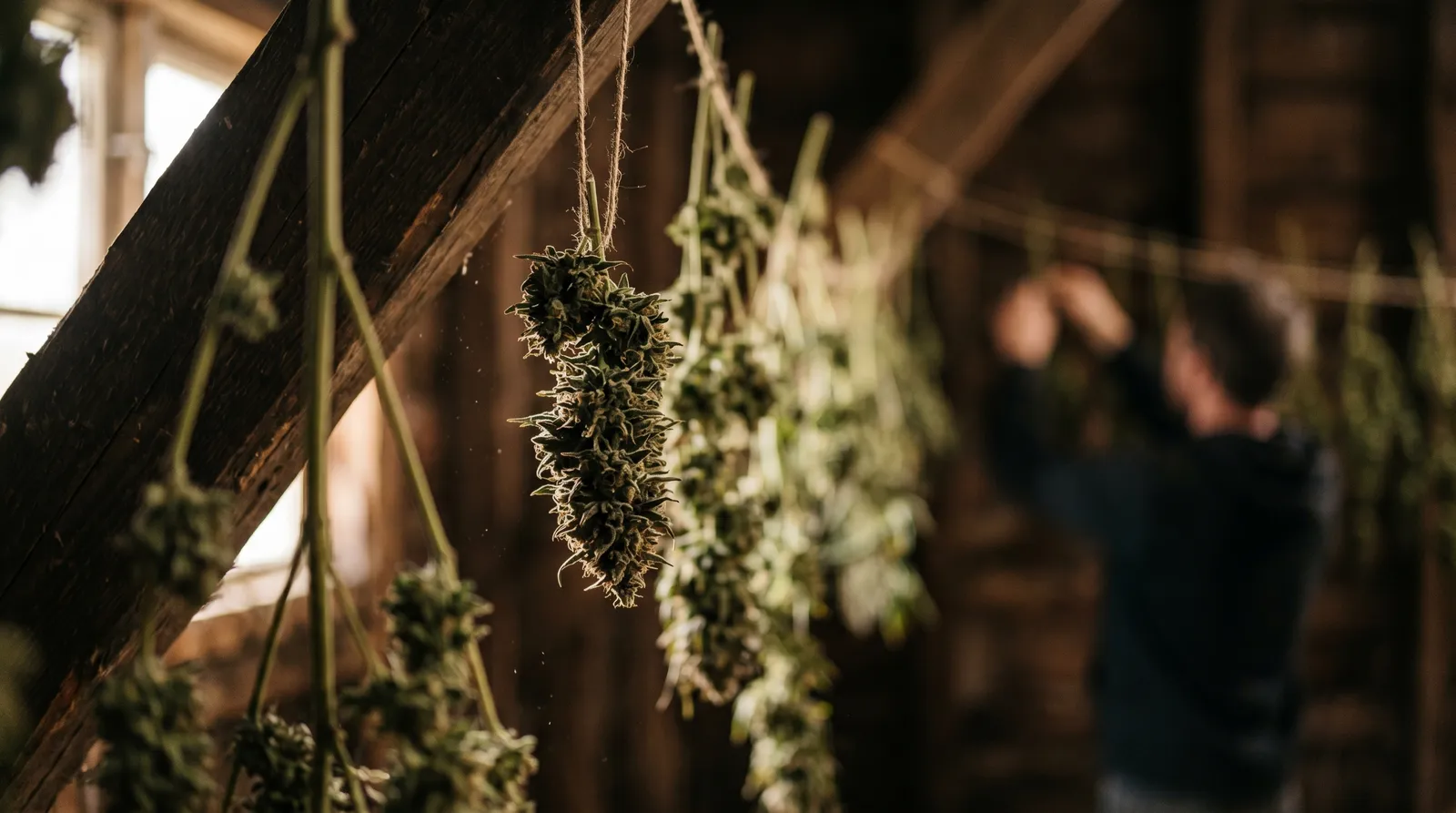
String a line or use drying racks. Hang branches or individual buds with space between them — no touching. Crowded buds trap moisture and are where mould starts. If you're rack-drying trimmed buds, flip them once daily so the side touching the mesh doesn't flatten.
Step 5: Monitor humidity daily
Check the hygrometer every 12-24 hours. If RH climbs above 65%, increase airflow or dehumidify. If it drops below 50%, slow things down with a humidifier or seal the room tighter. A humidity swing from 70% down to 40% over 24 hours will crispy-dry the outside of the bud while the inside stays wet — the classic recipe for moist jars and surprise mould during cure.
Step 6: Check daily for problems
Look for fuzzy white or grey spots (Botrytis), dusty black or green patches (Aspergillus, Penicillium), or sour/ammonia smells. Any of these means contaminated material — remove the affected buds and anything touching them immediately. Do not smoke mouldy cannabis; documented case reports link it to pulmonary aspergillosis, particularly in immunocompromised users (Cescon et al., 2008, Journal of Clinical Microbiology).
Step 7: The snap test
After 7-10 days, bend a small stem. If it snaps cleanly with an audible crack, the dry is done. If it bends rubbery, give it another day or two. The outside of the bud should feel dry to the touch but the interior still retains some moisture — this is deliberate, because curing finishes the job.
Drying methods compared
| Method | Time | Terpene retention | Mould risk | Best for |
|---|---|---|---|---|
| Whole-plant hang | 10-14 days | Excellent | Low-moderate | Dry climates, slow dry preference |
| Branch hang | 7-10 days | Very good | Low | Most home growers |
| Rack drying | 5-8 days | Good | Moderate | Wet-trimmed buds, limited vertical space |
| Paper bag | 3-5 days | Fair | Moderate-high | Small harvests, emergencies only |
| Low-heat dehydrator | 24-48 hours | Poor | Low | Not recommended — kills terpenes |
| Freeze drying | 24-36 hours | Excellent (if done right) | Very low | Lab-grade equipment only |
From dry to cure — don't stop here
Drying is only half the job. Once stems snap, move the buds into airtight glass jars (Mason jars are the standard) filled to about 75% capacity. Include a two-way humidity pack rated for 58-62% RH — Boveda and Integra Boost are the widely-used brands. For the first week, open the jars once daily for 5-10 minutes to release accumulated moisture and exchange air. This is "burping." After week one, burp every 2-3 days; after week two, weekly is fine. A full cure takes 2-4 weeks minimum; many growers go 4-8 weeks for premium flower. Cured properly, flower stores at peak quality for 6-12 months in a cool, dark place.
Safety, contamination and what can go wrong
The single biggest drying failure is mould. Aspergillus, Botrytis cinerea (bud rot), and Penicillium species can establish colonies in hours under the right conditions — stagnant air, RH above 65%, dense crowded buds. A 2017 survey of California cannabis samples found detectable Aspergillus contamination in 26% of tested flower (Thompson et al., 2017, Clinical Microbiology and Infection). Smoking contaminated cannabis has been linked in case literature to invasive pulmonary aspergillosis in immunocompromised patients, with several documented fatalities. Visual inspection catches obvious contamination; subtle colonisation may not be visible without a microscope or lab test.
Other drying hazards: over-drying below 45% RH crumbles trichomes and loses terpenes irreversibly. Drying with direct fan airflow on buds causes uneven drying — outer layers crisp while interiors stay wet. Drying in warm rooms above 24°C accelerates terpene loss and increases decarboxylation. Drying under any light (even indirect sunlight) degrades THC to CBN over time, which shifts the effect profile toward sedation.
If you're drying cannabis alongside other substances or are a medical cannabis patient, worth noting: the pharmacology doesn't change with drying quality, but the dose does. Properly dried and cured flower tests higher in total cannabinoids by weight because water has been removed. A rushed, partially-dried bud smoked at the same gram-weight delivers less active material. This matters for patients titrating specific doses and for anyone combining cannabis with medications that interact via CYP3A4 and CYP2C9 — notably warfarin, clobazam, and tacrolimus (Alsherbiny & Li, 2019, Medicines).
Interaction reference
| Medication class | Interaction | Risk level |
|---|---|---|
| Warfarin | CBD inhibits CYP2C9, increasing INR | High |
| Clobazam / benzodiazepines | CBD raises active metabolite levels | High |
| SSRIs / SNRIs | Additive serotonergic effects, altered metabolism | Moderate |
| Alcohol | Additive CNS depression, increased THC absorption | Moderate |
| Opioids | Additive sedation, respiratory risk at high doses | Moderate |
| Caffeine | May blunt sedation, altered subjective effect | Low |
Emergency information
If mouldy cannabis has been consumed by someone with a compromised immune system, or if anyone develops fever, chest pain, or difficulty breathing after exposure to a heavily contaminated drying space, contact emergency services. In the Netherlands: Nationaal Vergiftigingen Informatie Centrum (NVIC) — 030 274 8888 (medical professionals only, 24/7). In Belgium: Antigifcentrum — 070 245 245. In Germany: Giftnotruf Berlin — 030 19240. Tell medical staff exactly what was consumed or inhaled, including suspected mould exposure.
Commercial disclosure
Azarius sells storage jars, hygrometers, humidity packs, and drying-related equipment and has a commercial interest in this topic. Editorial content is reviewed independently to minimise commercial influence.
References
- Cervantes, J. (2006). Marijuana Horticulture: The Indoor/Outdoor Medical Grower's Bible. Van Patten Publishing.
- Birenboim, M., Brikenstein, N., Duanis-Assaf, D., Maurer, D., Chalupowicz, D., & Kenigsbuch, D. (2023). Effect of drying temperature on cannabis terpene profile. Postharvest Biology and Technology.
- Punja, Z. K. (2021). Epidemiology of Botrytis cinerea on cannabis. Frontiers in Microbiology, 12.
- McPartland, J. M. (1994). Cannabis pathogens. Journal of the International Hemp Association.
- Thompson, G. R., Tuscano, J. M., Dennis, M., et al. (2017). Aspergillus contamination in commercial medical cannabis. Clinical Microbiology and Infection, 23(4).
- Cescon, D. W., Page, A. V., Richardson, S., et al. (2008). Invasive pulmonary aspergillosis associated with marijuana use. Journal of Clinical Microbiology, 46.
- Tanney, C. A. S., Backer, R., Geitmann, A., & Smith, D. L. (2021). Cannabis glandular trichomes: a review. Plants, 10(12).
- Alsherbiny, M. A., & Li, C. G. (2019). Medicinal cannabis — potential drug interactions. Medicines, 6(1).
- Rosenthal, E. (2010). Marijuana Grower's Handbook. Quick American Publishing.
- Leafly Cultivation Review (2021). Moisture loss and weight yield in cannabis drying.
Last updated: April 2026
Domande frequenti
8 domandeHow long does cannabis take to dry?
What humidity should I dry cannabis at?
Can I dry cannabis faster with heat or a dehydrator?
How do I know when cannabis is dry enough to cure?
What's the difference between wet-trim and dry-trim drying?
Can you smoke mouldy cannabis?
How do I know when cannabis buds are properly dried?
Should I dry whole branches or trim buds first?
Informazioni su questo articolo


Joshua Askew serves as Editorial Director for Azarius wiki content. He is Managing Director at Yuqo, a content agency specialising in cannabis, psychedelics and ethnobotanical editorial work across multiple languages. Th
Questo articolo wiki è stato redatto con l’assistenza dell’IA e revisionato da Joshua Askew, Managing Director at Yuqo. Supervisione editoriale di Adam Parsons.
Avviso medico. Questi contenuti hanno finalità esclusivamente informative e non costituiscono un parere medico. Consulta un operatore sanitario qualificato prima di utilizzare qualsiasi sostanza.
Ultima revisione 26 aprile 2026